Generative AI Engineer | Cyber-Physical Systems
Nashville, TN | phamminhquang289@gmail.com
I'm a Software Engineer with 3+ years of experience developing and integrating safety-critical, software-intensive systems for automotive applications. My expertise spans from low-level embedded firmware to cloud-based AI deployment, with a proven track record of transitioning research innovations into robust, validated systems.
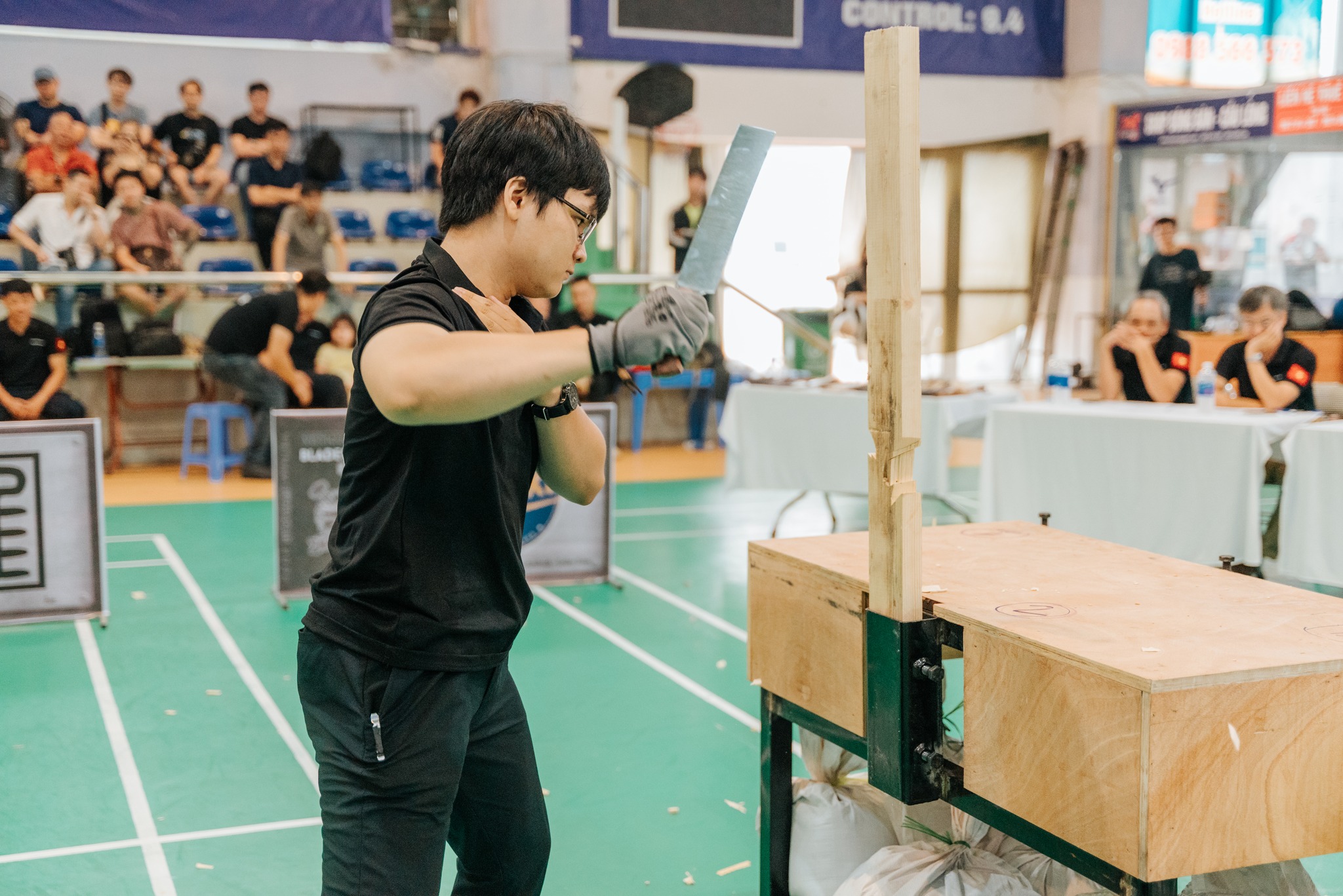
Competing at Bladesports 2022
I hold an M.Eng. in Cyber-Physical Systems from Vanderbilt University and combine deep technical skills in C/C++ and Rust with applied expertise in generative AI, formal verification, and DevOps infrastructure. My work focuses on ensuring reliability and deterministic performance in resource-constrained, high-stakes environments.
Applying emerging technologies to real-world problems, with a focus on cyber-physical systems, edge AI, and compliance in safety-critical environments.
Outside of software development, I'm a hobbyist bladesmith and metalworker. I compete in Bladesports competitions, where precision craftsmanship meets hands-on problem solving—skills that translate directly to my approach in engineering: attention to detail, iterative refinement, and building reliable systems from the ground up.
Grew up watching The Terminator franchise. Now I build AI 🤖
M.Eng. in Cyber-Physical Systems | 2026

M.Eng. in Energy Systems | 2023
B.Eng. in Electrical and Electronics Engineering | 2022
High School Diploma | 2017
AKA "Nguyen Khuyen High School", notorious for its high-pressure, strict, military-like and iron discipline.
Vanderbilt University, College of Connected Computing
April 2026 – Present
Building and integrating generative and agentic AI into real-world workflows; deploying LLM-based tooling and infrastructure for university-wide research and educational use cases.
Institute for Software Integrated Systems, Vanderbilt University
May 2025 – April 2026
Researched Mixture-of-Experts architectures and formal neural network verification for fault-tolerant AI in safety-critical embedded systems. Developed Rust-based test frameworks and bridged AI/ML capabilities with cyber-physical systems safety requirements.
Vanderbilt University IT Department
February 2025 – August 2025
Part-time technical support role managing classroom AV systems, troubleshooting audio-visual equipment, and providing technology assistance for academic events.
Bosch Global Software Technologies Vietnam
April 2023 – December 2024
Full-cycle embedded software development and integration for safety-critical automotive systems. Led CI/CD pipeline development using Jenkins, achieving 50% reduction in system integration time. Designed and executed integration tests for RH850-based automotive ECUs, and developed power steering systems for Subaru and Honda OEMs. Administered Bitbucket repositories and JIRA for 5+ automotive projects.
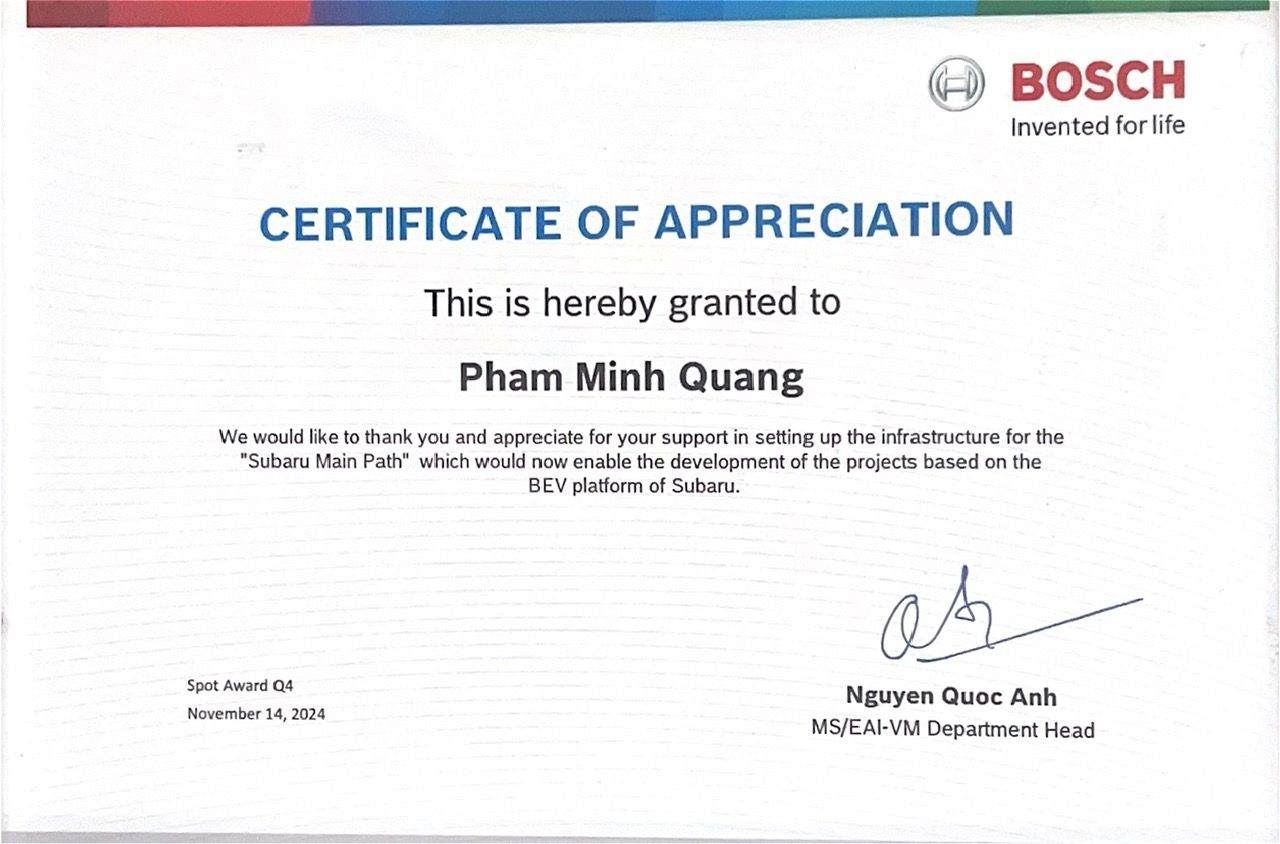
November 14, 2024
Recognized for setting up infrastructure for the "Subaru Main Path" to enable development of projects based on the BEV platform.
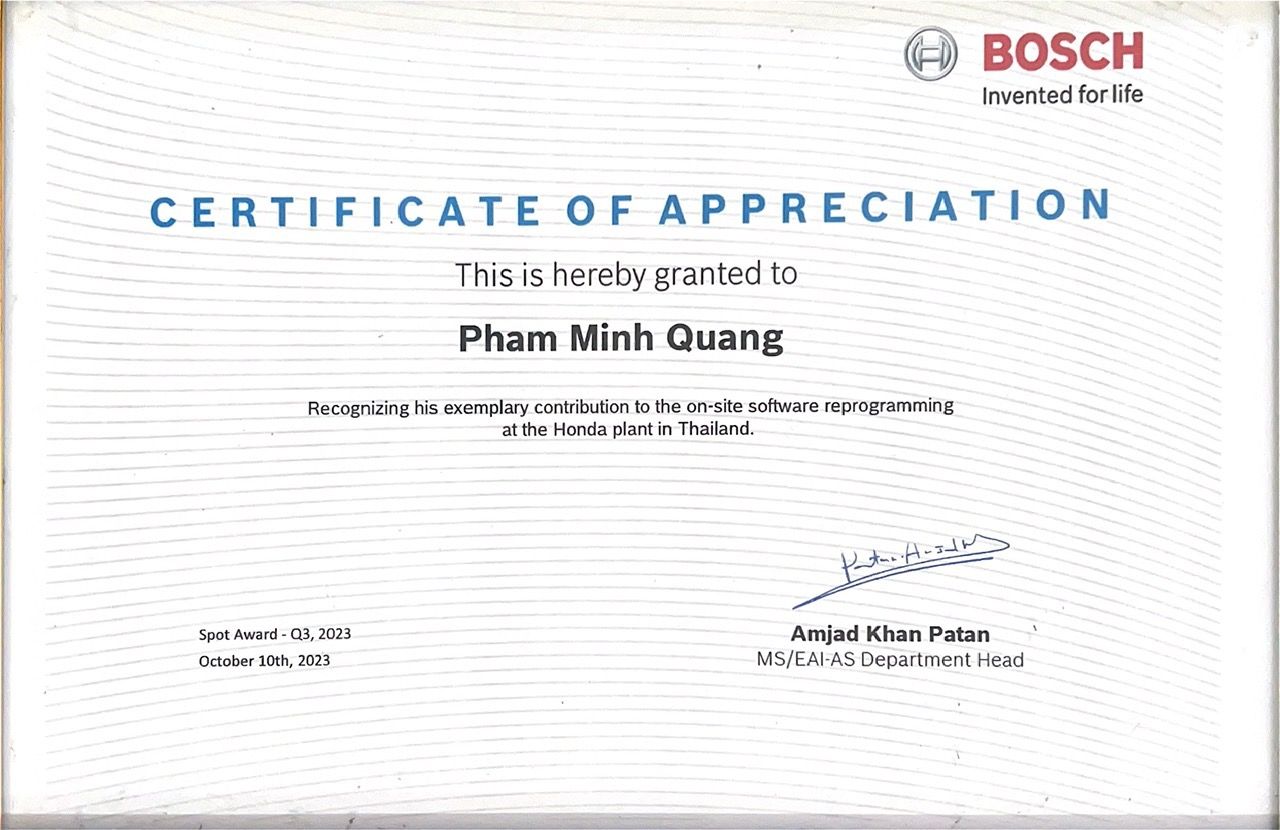
October 10, 2023
Recognized for exemplary contribution to on-site software reprogramming at the Honda plant in Thailand, minimizing production downtime.
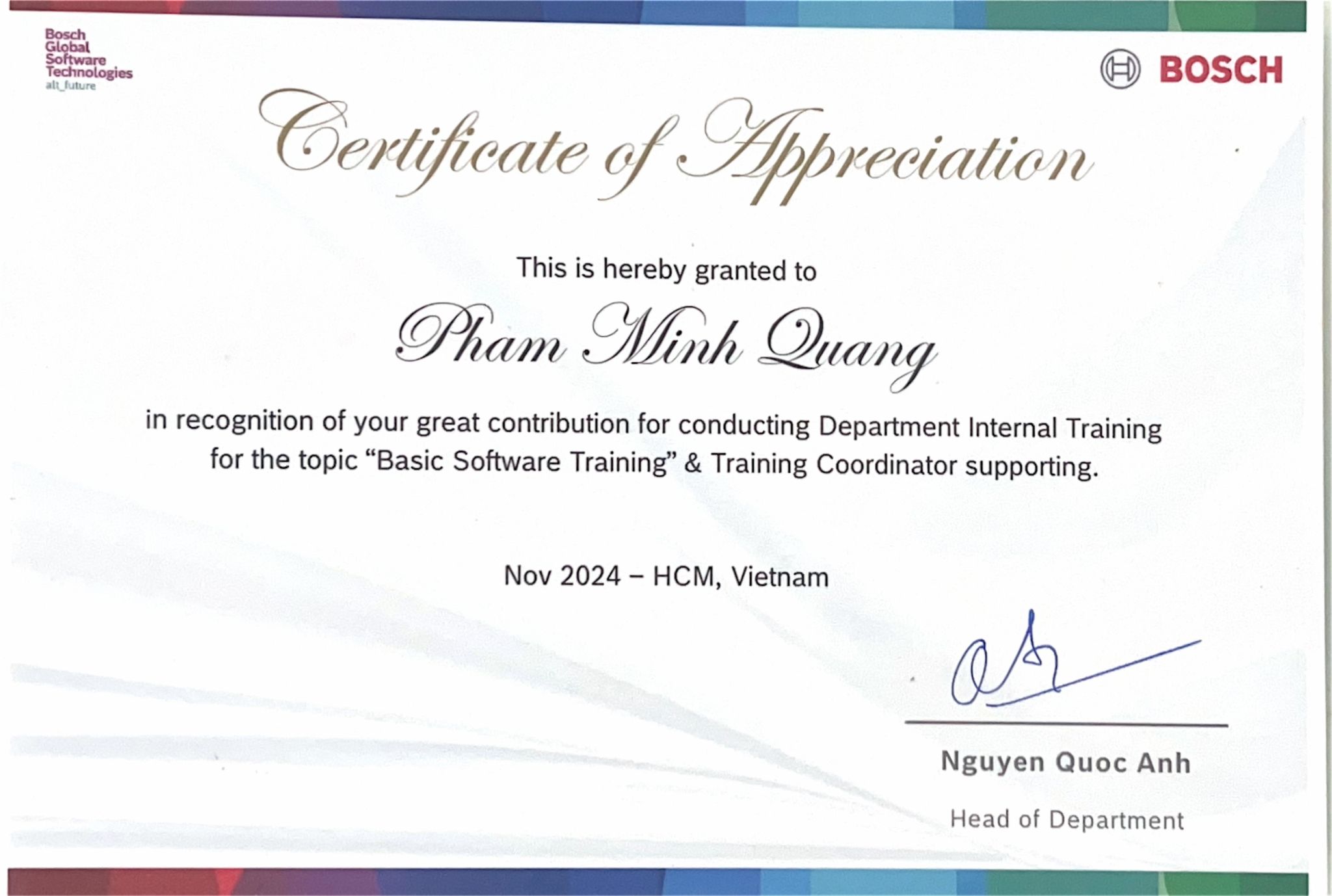
November 2024 – HCM, Vietnam
Recognized for conducting Department Internal Training on "Basic Software Training" and supporting as Training Coordinator.
Authors: Pham, M.Q., Dang, M.D., and others
Research focused on developing a mini SCADA system to monitor and control voltage in rooftop photovoltaic systems. Addresses the paradoxical overvoltage problem that emerges as PV installations increase, providing solutions for stable real-time control in cyber-physical systems.
Authors: Pham, M.Q., and Van Nguyen, N.
Published in "AETA 2022—Recent Advances in Electrical Engineering and Related Sciences" (Lecture Notes in Electrical Engineering, vol 1081, Springer). Studies Active Neutral Point Clamped (ANPC) converters for low- and medium-voltage applications, implementing Carrier-based Sine PWM control schemes for voltage balancing with Si IGBT and SiC MOSFET switches.
Open-source contributions to Rust-CUDA compiler infrastructure
Contributed 2 merged PRs fixing critical memory management bugs in Rust-CUDA compiler. PR #289: Fixed undefined behavior by replacing incorrect LLVMBuildPointerCast with proper LLVMBuildAddrSpaceCast for GPU address space transitions. PR #293: Implemented compile-time constant memory overflow detection with 64KB limit validation, detailed diagnostics, and --use-constant-memory-space flag.
Automotive security simulator for autonomous vehicle CAN bus networks
Virtual Hardware Security Module built in Rust simulating 9-ECU autonomous vehicle CAN bus with HMAC-SHA256 MAC authentication and CRC32 verification. Features secure boot, protected memory, attack detection with emergency shutdown, and real-time security monitoring dashboard. Implements threshold-based intrusion detection with structured error handling.
Institute for Software Integrated Systems, Vanderbilt University
Research on Mixture-of-Experts architectures for fault-tolerant AI in safety-critical systems. Implementing formal neural network verification with alpha-beta-CROWN to guarantee robustness. Achieved 100% verification success on test samples with formal robustness certificates for classification.
Closed-loop control system with automated CI/CD and monitoring
Adaptive Cruise Control (ACC) system built with MATLAB/Simulink and ROS. Automated testing via GitHub Actions, real-time monitoring with Grafana dashboards, and timestamped PDF reports for vehicle simulations.
Memory-safe surveillance system for edge devices
Security-focused camera system in Rust emphasizing memory safety and performance for edge computing. Demonstrates low-level system design with secure coding practices.
LLM-powered code documentation automation
AI tool using locally hosted Llama 3 for automated code documentation and commenting. Demonstrates practical LLM deployment for real-world software engineering.
Distributed FreeRTOS system with real-time scheduling
Distributed embedded system combining Tiva TM4C1294 microcontroller with Raspberry Pi 4 running FreeRTOS. Features mutex synchronization, semaphores, and intelligent PWM brightness control with USB serial communication.